

Rita Safariants
Associate Professor of Russian
PhD, Yale University
- Office Location
- 422 Lattimore Hall
- Telephone
- (585) 275-4251
Office Hours: Monday and Wednesday 12:30 - 1:30 pm, and by appointment
Biography
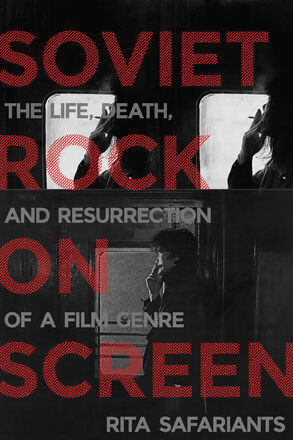
Rita Safariants's scholarly and pedagogical interests include late-Soviet, post-Soviet and contemporary Russian film, Russian literature, media, popular music, and performance culture. Her book, Soviet Rock on Screen: The Life, Death, and Resurrection of a Film Genre (University of Wisconsin Press, 2026) is the first study to examine the role of rock music in the last decade of Soviet cinematic production and its reverberations in the Putin era. The monograph investigates how the introduction of rock music into officially sponsored film projects redefined the Soviet film industry’s audience, marketing strategies, and film production practices, ushering in a new model of semi-privatized, market-driven filmmaking that established the rock performer as an enduring national emblem. Safariants argues that the fusion of rock music and cinema in the last Soviet decade produced a new film genre, the Soviet rock film, which reflected and embodied key cultural mechanisms that led to the collapse of the USSR. With the disintegration of the Soviet system in the 1990s, the rock film waned in its cultural clout, experiencing what Safariants argues to be an aesthetic and ideological death, only to be revived and reconstituted after Russia’s authoritarian turn under Vladimir Putin. Safariants is currently working on a second book project tentatively titled The Bureaucracy of Rock-n-Roll: Counterculture and the (post) Soviet State, which challenges existing scholarship on late-Soviet cultural production and offers new ways of conceptualizing Russia’s neo-totalitarian turn through the lens of rock music and popular culture.
Research Overview
Research Interests
- Soviet and Post-Soviet cinema
- Soviet and Russian official and unofficial popular music
- Russian literature, adaptation studies, gender studies, media and performance culture
Courses Offered (subject to change)
- RUSS 233: Russian Women Writers
- RUSS 252: Hipsters, Rebels and Rock Stars in Russian Literature and Culture
- RUSS 264: Russian Literature Outside of Russia
- RUSS 267: Soviet Cinema
- RUSS 269: Russian Cinema after the Fall
- RUSS 272: Russian Movies That Rock
Selected Publications
- “The Rock-and-Roll Auteur: Sergei Solovyov’s ‘Youthful Insanity,’” forthcoming in Soviet Auteur Cinema, ed. Marina Rojavin and Tim Harte (Madison: University of Wisconsin Press).
- “The Rock-and-Roll State: Popular Music, Print Culture, and Soviet Bureaucracy,” Media Cultures of the Russian 1990s, ed. Maya Vinokour (Amherst: Amherst College Press, 2025), 93-118.
- “Post-Tsoi, or the Sincerity of Historical Anxiety: Sergei Shnurov and late-Soviet Rock Culture,” Slavic and East European Journal 68.4 (Winter 2024): 459-480. Special cluster: “Sergei Shnurov, Leningrad, and the Ends of Irony,” eds. Tatiana Efremova and Kevin M.F. Platt.
- “Filming the Criminal Mind: Josef von Sternberg’s and Lev Kulidzhanov’s Adaptations of Dostoevsky’s Crime and Punishment.” Slavic and East European Journal 67.1 (Spring 2023): 20-45.
- “From Pugacheva to Pussy Riot: Gender Performance in Russo-Soviet Popular Music.” Canadian-American Slavic Studies 56 (2022): 200-230. (Special issue of journal: “Pussy Riot: 10th Anniversary of the Punk Prayer,” ed. Kat Hill and Eliot Borenstein.)
- “VGIK’s School of Rock: Legacies of Popular Music on Film.” Studies in Russian and Soviet Cinema. Issue 13 (2), 2019. 208-216.
- “Thank God We’re Not Alive: The rock star in Soviet and post-Soviet cinema". Ruptures and Continuities in Soviet/Russian Cinema. Eds. Birgit Beumers, Eugenie Zvonkine. Routledge: 2018. 90-107.
- “Chekhov on the Screen: Lady with Little Dog (1960) and Vanya on 42nd Street (1994)” with John MacKay.MLA Approaches to Teaching the Works of Chekhov. Eds. Michael Holquist, Michael C. Finke. MLA: 2016. 123-140.
- “The Grandfather of Russian Rock: Aleksandr Vertinsky and his unlikely musical progeny.” Transactions of the Association of Russian-American Scholars in the USA (Festschrift in honor of Vladimir Alexandrov). Vol. 38, 2013. 263-282.
- “Literary Bilingualism and Codeswitching in Vladimir Nabokov’s Ada.” Ulbandus: A Slavic Review of Columbia University. Vol.10, 2006-2007. 191-211.
Honors and Activities
- 2025 ASEEES First Book Subvention Award
- 2022 University of Rochester Humanities Project: “Viktor Tsoi: Rock & Roll, and the Soviet State” International symposium (September 22-24, 2022)
- Spring 2020 Fellow, University of Rochester Humanities Center
- 2019 NEH digital humanities project award. Collaborator on “The Post-Soviet Public Sphere: Multimedia Sourcebook of the 1990s”
- 2018 Dobro Slovo National Honor Society
- 2016-2017 Andrew W. Mellon Postdoctoral Fellowship in Russian, Bowdoin
- 2014 Vassar College Faculty Research Grant for Manuscript Work (Elinor Nims Fund)
- 2012 Vassar College Faculty Summer Research Grant
- 2010 Associates in Teaching Fellowship, Yale University
- 2010 Nina Berberova Memorial Fund Award, Yale University
- 2009-2010 Annie K. Garland Fellowship (as part of the University Dissertation Fellowship), Yale University
- 2005-2006 AAASS New England Graduate Student Essay Prize
- 2004-2005 Richard Franke Interdisciplinary Fellowship, Yale University
- 2004 Phi Beta Kappa