
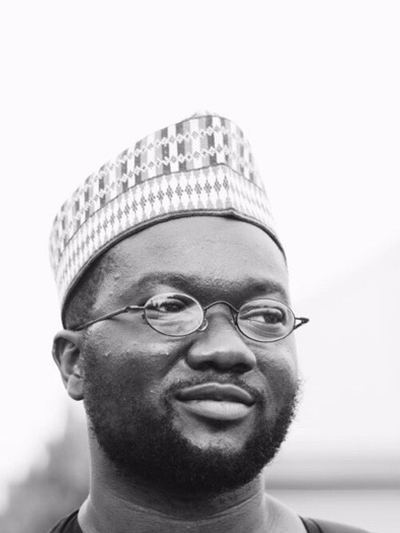
Abdulbasit Kassim
James P. Wilmot Distinguished Assistant Professor
Assistant Professor of Religion
PhD, Rice University
Research Active
- Office Location
- 417 Rush Rhees Library
Office Hours: By appointment
Research Overview
Abdulbasit Kassim is an Assistant Professor specializing in the histories and cultures of Muslim societies with a geographical focus on West Africa and the African Diaspora. His research focuses on the continuities and changes in the intellectual history of African and African Diasporic Islamic traditions. Abdulbasit completed his Ph.D. at Rice University and also received extensive training in the Arabic intellectual heritage of Islamic Africa from the Sankore’ Institute of Islamic-African Studies International (SIIASI). Before joining the University of Rochester, Abdulbasit served as a Predoctoral Fellow at the Institute for the Study of Islamic Thought in Africa (ISITA) and Program of African Studies (PAS) at Northwestern University and a Postdoctoral Fellow for the Mellon Sawyer Seminar “Unarchiving Blackness: Why the Primacy of African and African Diaspora Studies Necessitates a Creative Reconsideration of Archives” at the Center for Ideas and Society, University of California, Riverside. He also served as a Postdoctoral Research Fellow at New York University’s Center for the Study of Africa and the African Diaspora (CSAAD) and an IDEAL Provostial Fellow at the Department of African and African American Studies at Stanford University.
Abdulbasit’s cross-temporal research spans the early modern and modern periods. By studying both the “yesterday” and the “today,” he traces the ebbs and flows of the intellectual networks, transregional scholarly communities, and the transmission and reception of canonical ideas in the Islamic traditions that circulated and connected the movement of people, caravans, texts, local histories, and material artifacts across the societies in Muslim West Africa, the Islamic West (al-Andalus and the Maghrib), the Islamic East (Mashriq) and the African Diaspora in the Atlantic world and Mediterranean Lands of Islam. His pedagogical focus situates the centuries-old literature and scholarly writings produced by Muslims of African descent in Arabic and African languages within a global conversation with other intellectual currents and disciplinary regimes across the world.
Abdulbasit's current book project, entitled Requiem for a West African Caliphate: A Social and Intellectual History of Islamicate Societies in Hausaland and Bornu, c. 1450-2015, examines the continuities, discontinuities, ruptures, and changes in the longue duréeof successive waves of Islamic reform, counter-reform, dissidence, rebellion, and jihad in Muslim West Africa. The nine-chapter book, divided into three parts (early modern, colonial, and post-imperial periods), tracks the textual practices, discursive productions, and doctrinal interpretations that reformers and dissidents in Muslim West Africa have debated, enunciated, and deployed to legitimize their projects of reform and jihad from the mid-fifteenth century, when scholars in the Maghrib such as Muḥammad b. ʿAbd al-Karīm al-Maghīlī al-Tilimsānī (d. 1504-5) and Jalāl al-Dīn al-Suyūṭī (d. 1505) taught the ‘core curriculum’ of pre-modern Islamic sciences and authored politico-theological manuals for state-building projects across Muslim West Africa to the early twenty-first century when new religious movements seeking to establish God’s rule attempted to overthrow the post-imperial secular polities and fragmented nation-states that were violently established during the twentieth-century European conquest. Requiem for a West African Caliphate tells the history of how Muslims have grappled with the nostalgia and loss of the caliphate and the common goals, divergent aspirations, and intersecting methods that different religious movements in Muslim West Africa, particularly Hausaland and Bornu, have proposed toward the idea of reclaiming the medieval and early modern Islamic thought and political practices that governed the defunct African Islamic empire-states and Islamicate societies in their pristine form as they imagined them to have been before colonialism. Abdulbasit is also working on a second book project, tentatively titled From the Black Atlantic to Sankoré. This book traces the intellectual contributions of Muslims of African descent from the Black Atlantic and the African Diaspora to the global transmission, circulation, preservation, and bio-bibliographic documentation of the centuries-old African Islamic intellectual heritage.
Abdulbasit is the co-editor of the book The Boko Haram Reader: From Nigerian Preachers to the Islamic State (Oxford University Press & Hurst Publishers, 2018), nominated for the best critical edition or translation into English of primary source materials on Africa by the African Studies Association (Paul Hair Prize). He has conducted ethnographic and archival research in Nigeria, Niger, Mali, Senegal, Sudan, Algeria, and Morocco. His work has received support from the Andrew W. Mellon Foundation, the American Council of Learned Societies, the American Philosophical Society, the African Studies Association, Rice University’s Boniuk Institute, and Rice University’s Baker Institute, among others. He is a member of the American Academy of Religion (AAR), American Historical Association (AHA), African Studies Association (ASA), Association for the Study of Worldwide African Diaspora (ASWAD), Lagos Studies Association (LSA), and Islam in Africa Studies Group.
Research Interests
- Histories and Cultures of Muslim Societies
- Islamic History and Civilization
- Islamic Thought
- African and African Diaspora Islamic Intellectual Traditions
- Arabic and Ajami Literature of Africa
Selected Publications
- The Boko Haram Reader: From Nigerian Preachers to the Islamic State (with Michael Nwankpa) New York: Oxford University Press, 2018; London: Hurst Publishers, 2018. (384 pp.)
- Boko Haram’s Internal Civil War: Takfīr and Jihād as a Recipe for Schisms” in Boko Haram Beyond the Headlines: Analyses of Africa’s Enduring Insurgency, edited by Jacob Zenn, 1-32. West Point, NY: Combating Terrorism Center, 2018.
- "Defining and Understanding the Religious Philosophy of Jihadi-Salafism and the Ideology of Boko Haram" Journal of Politics, Religion and Ideology 16, no. 2-3 (2015): 173-200.
Teaching
- Black History in Islam
- The Life of Prophet Muhammad and the Beginnings of Islam
- Quran and its Interpreters (Text, Exegesis, and Materiality)
- Islamic Thought and Literature
- Major Islamic Texts and Muslim Thinkers
- Pilgrimage Networks in Islam
- Muslim and Christian Societies in Africa
- Muslims Beyond the Arab World
- Global Black Muslim Diaspora in the Atlantic World and Mediterranean Lands of Islam
- History of Book and Manuscript Cultures in Islamicate Societies
- Archives, Libraries, and Texts in Islamic Africa