Female Growth and Development Study
The Female Growth and Development Study (FGDS) is a longitudinal study that began in 1987, following females with substantiated sexual abuse histories and matched comparisons (N = 173) across development. Using an accelerated longitudinal, cross-sequential design, participants have been assessed at multiple timepoints from late childhood through early adulthood, with a multi-level biopsychosocial approach. The study has maintained 96% retention and has also followed the next generation, with over 90% of offspring assessed in early childhood. FGDS is now extending into midlife through continued follow-up assessments supported by new funding by the National Institute on Aging (NIA). Recent study extensions include:
- New waves of data collection in midlife (T7 and T8), supported by National Institute of Child Health and Human Development
- Expanded assessment of daily stress and coping processes in real-world contexts
- Detailed cognitive assessments, including working memory, attention, processing speed, and reasoning
- Identification of modifiable behavioral health targets that may support long-term physical and cognitive well-being

Representative Publication: Trickett, P. K., Noll, J. G., Susman, E. J., Shenk, C. E., & Putnam, F. W. (2010). Attenuation of cortisol across development for victims of sexual abuse. Development and psychopathology, 22(1), 165–175. https://doi.org/10.1017/S0954579409990332
TechnoTeens
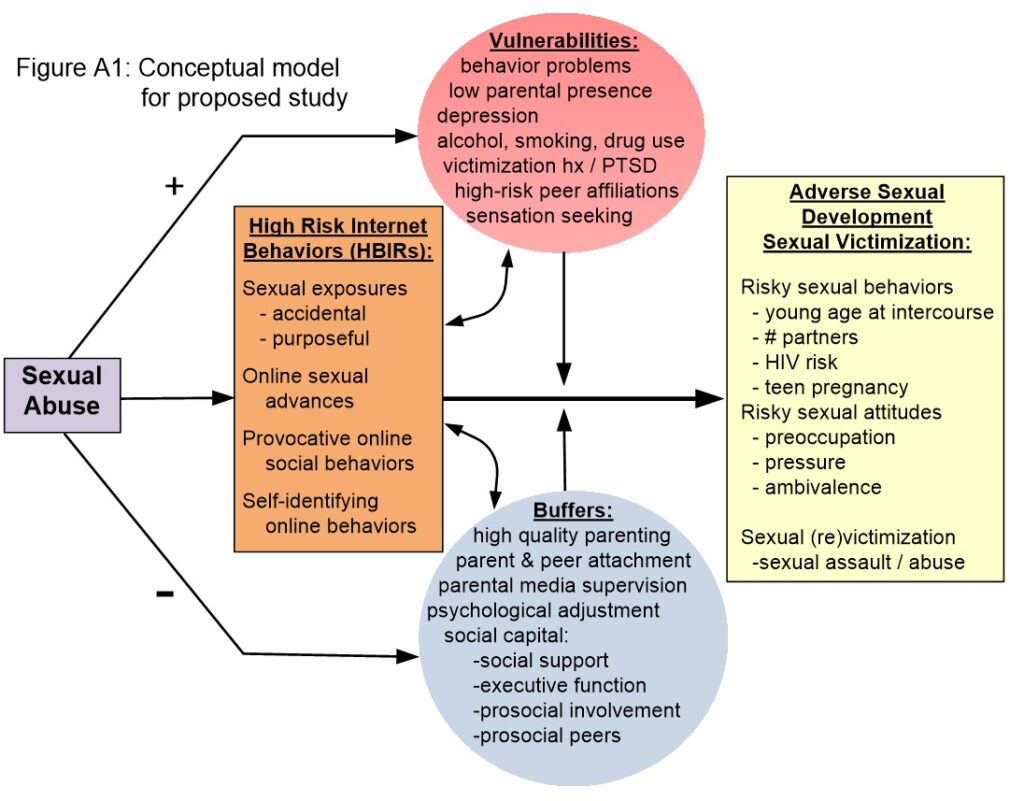
TechnoTeens examines how adolescents navigate online environments and what places some youth at greater risk for harmful online experiences. Although most teens have regular internet access, many are exposed to or engage in high-risk internet behaviors (HRIBs), such as viewing sexually explicit content or sharing personal or provocative information online. Current safety efforts often rely on parental monitoring and adolescent self-report, leaving important gaps in understanding real-world behavior and risk.
This study addresses these gaps by identifying which adolescents are most vulnerable, with a particular focus on youth with prior adversity, and by using objective methods to capture online behavior. Key features of the study include:
- A sample of 400 adolescent females (ages 12 to 15), including youth with and without substantiated histories of sexual abuse
- The first study to move beyond self-report by capturing adolescents’ “internet footprints,” including all URL activity over a 4-week period
- Objective assessment of high-risk online behaviors both online and in controlled lab settings
- Longitudinal follow-up across adolescence (ages 12 to 18) using an accelerated, cross-sequential design with repeated assessments
- Comprehensive psychosocial interviews to identify risk and protective factors, including online behaviors such as pornography use, provocative self-presentation, and offline meetings
Findings from TechnoTeens aim to provide more accurate estimates of high-risk internet behaviors and clarify their impact on adolescent development. This work is designed to inform more effective internet safety programs and guide prevention and intervention efforts for adolescents, families, and policymakers.
Representative Publication: Noll, J.G., Haag, A., Shenk, C.E., Wright, M.F., Barnes, J.E., Kohram, M., Malgaroli, M., Foley, D.J., Kouril, M., & Bonanno, G.A. (2021). An observational study of internet behaviors for adolescent females following sexual abuse. Nature Human Behaviour, 6, 74-87. https://doi.org/10.1038/s41562-021-01187-5
Female Adolescent Development Study (FADS)
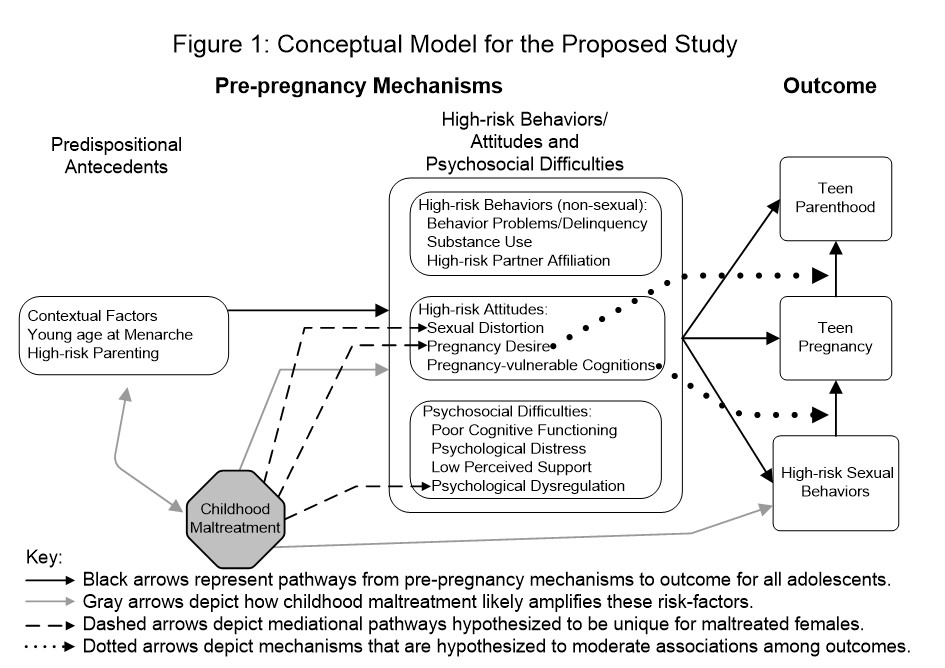
This work focuses on understanding how early experiences shape adolescent girls’ pathways related to sexual behavior, pregnancy, and early parenthood. The study aims to:
- Understand rates of high-risk sexual behaviors, teen pregnancy, and teen parenthood among adolescents with and without histories of maltreatment
- Identify early risk factors, including prior adversity, that contribute to these outcomes
- Examine how underlying mechanisms before pregnancy help explain links between early experiences and later outcomes
- Clarify developmental pathways that lead to different outcomes across adolescence
- Identify factors that may increase or reduce risk, shaping how these outcomes unfold over time
Representative Publication: Noll, J.G., & Shenk, C.E. (2013). Teen birth rates in sexually abused and neglected females. Pediatrics, 131(4), e1181-e1187. https://doi.org/10.1542/peds.2012-3072