

Laura Anderson
Instructional and Research Faculty
PhD, Knox College, 2000
- Office Location
- B40 Hutchison Hall
- Web Address
- Website
Office Hours: By appointment
Biography
Professor Laura L. Anderson completed her undergraduate studies at Knox College in 2000 and received her PhD from UC Berkeley in 2005 where she worked in the research labs of Professor John Arnold and Professor Robert G. Bergman studying the reactivity of tantalum imido complexes and acid-catalyzed hydroamination. After completing an NIH postdoctoral fellowship with Professor Keith A. Woerpel at UC Irvine developing methods for silirene transfer to nitriles, Professor Anderson began her independent career at the University of Illinois Chicago in 2008. She was promoted to Associate Professor in 2015 and Professor in 2025. From 2019 – 2025, Professor Anderson also served at a Program Director at the National Science Foundation in the Chemical Synthesis and Chemical Catalysis Programs and represented the Division of Chemistry in the National AI Institutes Program. She moved to the University of Rochester in January 2026 and is excited to join faculty in the Department of Chemistry. Professor Anderson’s research program is focused on the development of methods to initiate and control stereoselective pericyclic reactions of nitrones and hydroxylamine ethers for the synthesis of new Csp3-enriched heterocycles to broaden chemical space.
Research Overview
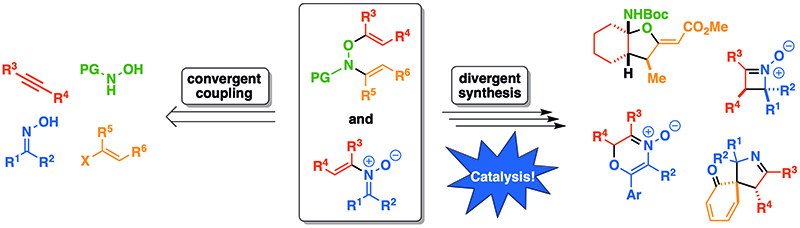
Heterocyclic molecules are commonly found in both medicinal and material applications. Due to the increasing demands for more efficient routes to known heterocycles and discoveries of new heterocycles, the design of innovative methods that facilitate access to these important scaffolds are required. To streamline the synthesis of heterocyclic molecules and expand the chemical space around these privileged structures, the Anderson Group has pursued the development of novel transformations that employ nitrone and hydroxylamine intermediates. We have discovered divergent conditions to unlock and control the reactivity embedded in the N–O bond of these compounds to achieve a diverse array of new reactions and efficiently prepare challenging C–O, C–N, and C–C bonds from simple starting materials. We have also developed complementary modular methods for generating nitrone and hydroxylamine rearrangement precursors using Chan-Lam-Evans reactions and conjugate addition strategies. Current research directions include reaction development of N-vinyl isoxazoline intermediates, optimization of tunable oxidation for improved copper-catalyzed C–N and C–O bond coupling of vinyl boronic acids with oximes, and asymmetric catalysis of electrocyclization and cascade reactions.
Research Interests
- Synthetic organic methods
- Pericyclic and cascade reactions
- Catalysis
- Heterocycle synthesis
Selected Publications
- Alshreimi, A. S.; Shim, E. J.; Wink, D. J.; Anderson, L. L. “Copper-Catalyzed Disruption of a Cascade Reaction: Synthesis of γ-Ketoamides from Nitrones and Ynamides” Org. Lett.2025, 27, 5989-5994.
- Alshreimi, A. S.; Zhang, G.; Shim, E. Wink, D. J.; Anderson, L. L. “Diastereoselective Synthesis of 2-Amino-1-Pyrrolines via Gold-Catalyzed N-Alkenylation of Isoxazolines and Rearrangement” ACS Catal.2024, 14, 2229-2234.
- Alonso, L.; Alshreimi, A. S.; Reidl, T. W.; Wink, D. J.; Anderson, L. L. “Substituent and Solvent Effect Studies of N-Alkenylnitrone 4π-Electrocyclizations” Chem. Eur. J.2023, 29, e202300551.
- Zhang, G.; Alshreimi, A. S.; Alonso, L.; Antar, A.; Yu, H.-C.; Islam, S. M.; Anderson, L. L. “Nitrone and Alkyne Cascade Reactions for Regio- and Diastereoselective 1-Pyrroline Synthesis” Angew. Chem. Int. Ed. 2021, 60, 13089-13097.
- Alshreimi, A. S.; Zhang, G. Reidl, T. W.; Peña, R. L.; *Koto, N.-G.; Islam, S. M.; Wink, D. J.; Anderson, L. L. “Synthesis of Spirocyclic 1-Pyrrolines from Nitrones and Arynes through a Dearomative [3,3]-Sigmatropic Rearrangement” Angew. Chem. Int. Ed.2020, 59, 15244-15248.
- Son, J.; Reidl, T. W.; Kim, K. H.; Wink, D. J.; Anderson, L. L. “Generation and Rearrangement of N,O-Dialkenylhydroxylamines for the Synthesis of 2-Aminotetrahydrofurans” Angew. Chem. Int. Ed.2018, 57, 6597-6600.