
Artist-in-Residence
Applications for the next Fanny Knap Allen Artist Residency will open early in 2028. We will seek artists or artist collectives whose practice centers on a specific media or approach. The selected artist or collective will be in residence at the University of Rochester to conduct research, develop a body of work, and teach studio art courses associated with their expertise and research interests. Teaching expectations include no more than three courses per academic year with additional expectations that encompass leading workshops, visiting classes, mentoring studio majors in the Senior Studio and Seminar course, and potentially supervising independent studies.
During the residency, the artist will develop a project that engages both the campus and the greater Rochester community. The residency necessitates at least one public presentation, exhibition, performance, screening, or installation per year.
Resident artists have access to the University’s rich resources, including labs and studios; performance and exhibition spaces; archives, libraries, research centers, and special collections. Health benefits, dedicated studio space in the Sage Art Center, and added support for research and production augment a single salary commensurate with qualifications and experience.
Artists
2026-2028: Abbey Muza
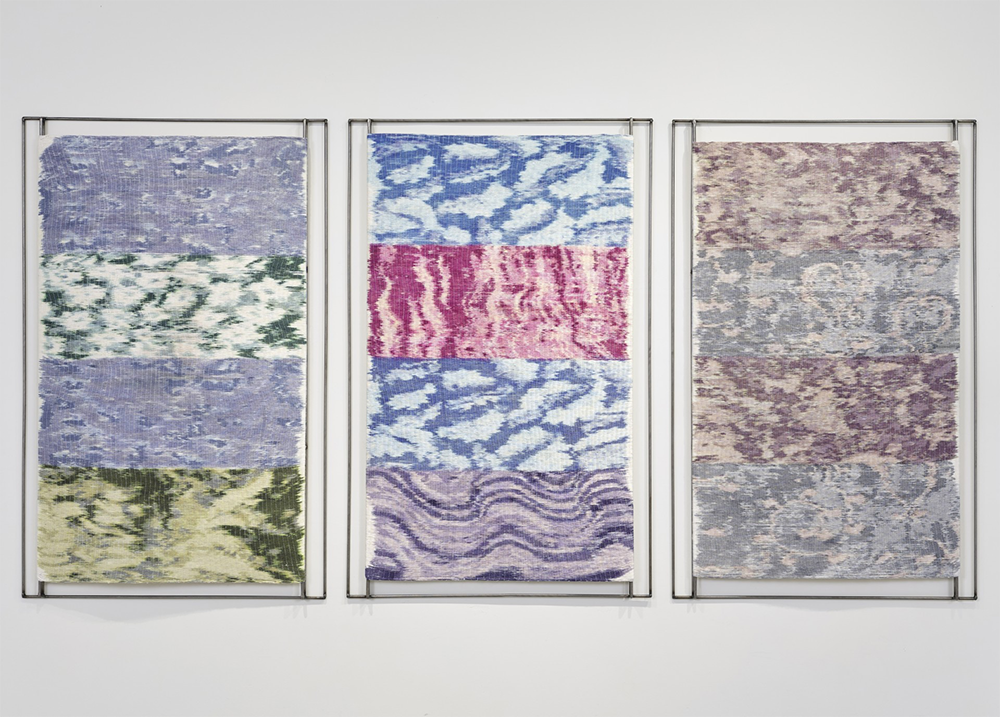
Abbey Muza uses weaving, textiles, and other media to engage with symbol and narrative. Their work is sourced from archival research, history, and literature. Narratives from these sources are collaged, edited, and abstracted into the drawn, dyed, and painted surfaces of their work. They are particularly interested in how histories and narratives can be retold through woven cloth in relation to textiles' ‘othered’ and gendered art-historical positioning, positioning the textile object as a natural encoding device for little-told or excluded narratives.
Muza’s recent work and textile-based research will be shown in a December 2026 exhibition in the Hartnett Gallery. This body of work draws on the historic use of symbols and narrative structures in medieval and modern textiles and cultural contexts, examining how symbolic meaning shifts over time and how symbol, truth, and opacity operate in the contemporary moment.
2023-2026: Carolyn Gennari
Carolyn Gennari restarted the department’s Artist in Residence program in 2023. Gennari’s versatility is evident in the employment of video, animation, performance, and sculpture. Her projects often start within museums and archives, advance into added relevancy through a reframing for present-day communities, sites, and events. This approach positions the archive as an active space, inviting contemplation on history and its interconnectedness with the contemporary. Gennari obtained her MFA from the Stamps School of Art and Design and her MA in Museum Studies from the University of Michigan.
Searching For What Isn’t There, is a 14 part film that combines archival and first-person research about the legacy of arctic exploration. This project stems from Gennari’s extensive research surrounding the voyages undertaken by Captain William Parry from 1819-1824, to find the northwest passage. Drawing from Parry’s journals, Inuit oral histories, and her experience traveling to the arctic, Searching For What Isn’t There positions the Northwest Passage as a metaphor for knowledge-construction and explores how legend continues to frame our understanding of the past. “…we are left to wonder then, where the frontier of history gives way to mythic space and its imaginaries...” (01:44)

Video still, total duration: 44:14
2018-2020: Ash Arder
Ash Arder piloted the Artist in Residence program which was put on hold during the pandemic. Arder is a transdisciplinary artist who creates idea- and object-based systems for interpreting and re-imagining interspecies relations (i.e., the relations between humans and plants). Her research-based approach examines these relationships primarily through pop culture and historic (both personal and shared) lenses. Arder presented her creative research from the first half of her residency in an exhibition titled A Study: Collision Detection at Hartnett Gallery in November of 2018.
A Study: Collision Detection—collision refers to the intersection of two or more objects, virtual or real; detection speaks to capturing that moment of intersection, specifically with regard to time and force of impact. In a series of new visual meditations, Ash Arder examines computer science techniques aimed at simulating the effects of natural phenomena like wind and rain on vegetation. Mathematical equations and computational systems are loosely translated into real life scenarios… or is it the other way around?
